News
Press Brake vs Hydraulic Press

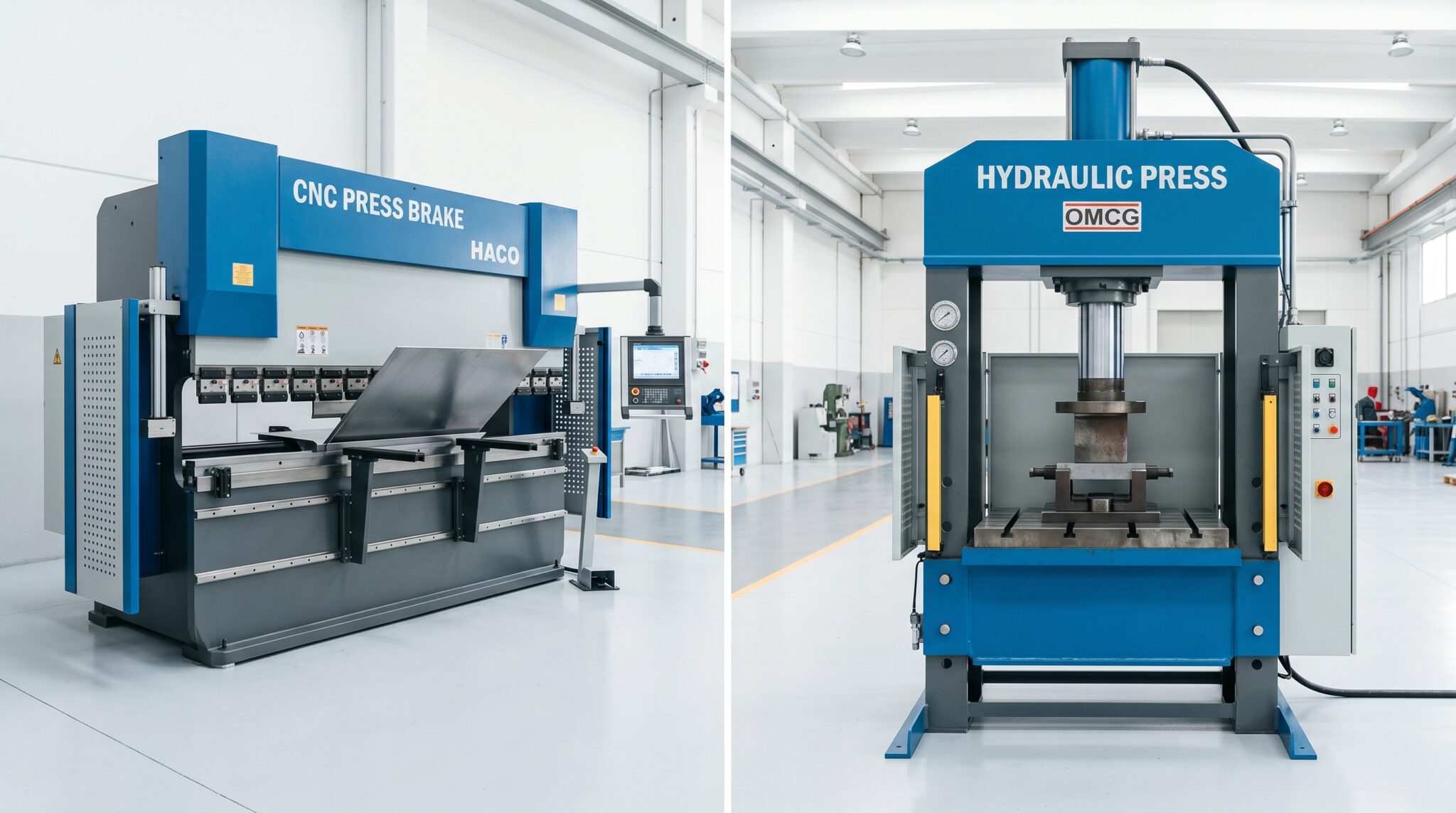
A press brake differs from a general-purpose hydraulic press in function and precision: a press brake is a purpose-built machine for bending sheet metal to exact angles using a punch-and-die system, while a hydraulic press is a versatile forming platform designed for compressive operations like stamping, deep drawing, and embossing. CNC press brakes achieve positioning accuracy of ±0.01mm, a level of angular control that general-purpose hydraulic presses cannot match.
Many people are conflating two distinct machine categories, because many press brakes use hydraulic drive systems and the terminology overlaps. The meaningful comparison is between a press brake — of any drive type — built for precision bending, and a general-purpose hydraulic press built for brute-force forming.
This guide covers both machines from the ground up. You will find clear definitions, a breakdown of press brake types and bending methods, direct comparisons across precision, speed, tonnage, and operating costs, and a practical decision framework to help you choose the right machine for your application.
Whether you are evaluating your first press brake or deciding whether a general-purpose hydraulic press can substitute for a dedicated bending machine, a press brake manufacturer like ACCURL can help you identify the right configuration for your production requirements.
Why Do People Confuse Press Brakes and Hydraulic Presses?
Many people confuse press brakes and hydraulic presses because many press brakes use hydraulic drive systems, which creates terminology overlap that suggests the machines are interchangeable — when they are fundamentally different in purpose and precision.
There are 3 specific sources of this confusion.
First, terminology overlap causes the greatest misunderstanding: the phrase “hydraulic press brake” contains the words “hydraulic press,” leading to assume equivalence between a hydraulic press brake and a general-purpose hydraulic press.
Visual similarity reinforces the mistake, too — both machines use a ram and bed configuration, but a press brake uses that configuration for controlled angular bending while a hydraulic press uses it for flat compressive forming.
Third, CNC refers to the control system architecture, not the drive type, so a CNC press brake can be hydraulic, servo-electric, or hybrid in its drive mechanism. This distinction confuses buyers who assume “CNC” and “hydraulic” describe competing machine categories rather than different system layers.
Understanding why this confusion exists prepares you for the detailed technical comparison that follows, where each machine’s capabilities are measured against specific performance parameters.
What Is the Core Difference Between a Press Brake and a Hydraulic Press?
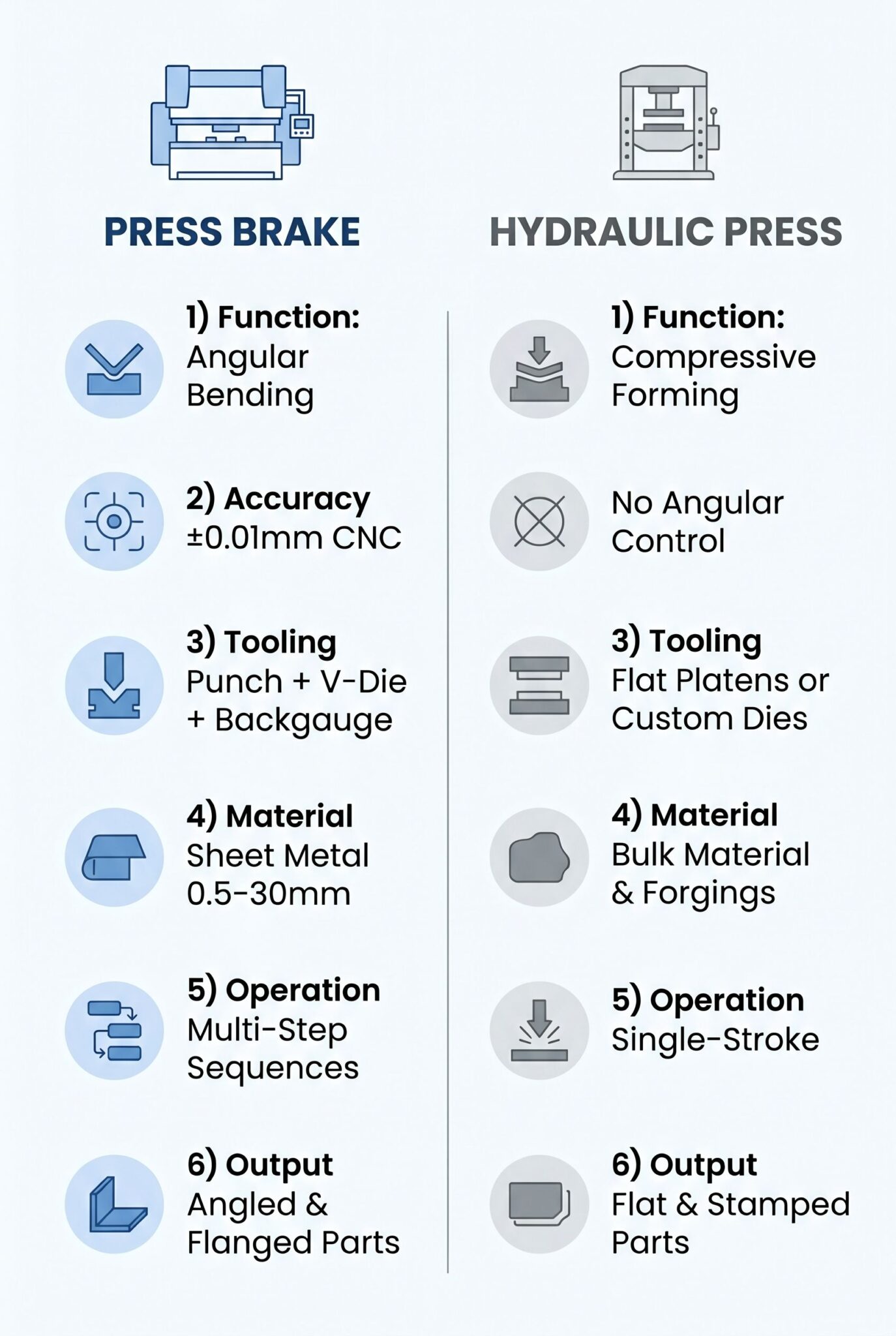
A press brake differs from a general-purpose hydraulic press in purpose and precision: a press brake bends sheet metal to programmed angles using a punch-and-die system with backgauge positioning, while a hydraulic press applies brute compressive force for stamping, drawing, and forming without angular precision.
Six key factors define this comparison.
In primary function, a press brake performs controlled angular bending of sheet metal, while a hydraulic press performs compressive forming, stamping, and deep drawing on bulk or sheet material.
In precision capability, a CNC press brake achieves positioning accuracy of ±0.01mm and angle accuracy of ±0.3–0.5° with real-time measurement, while a general-purpose hydraulic press offers no angular control at all.
Tooling tells a similar story.
A press brake uses a dedicated punch, die, and backgauge system where V-die openings are matched to material and angle requirements, while a hydraulic press uses flat platens or custom dies without angular reference.
In material handling, a press brake processes sheet metal and plate from 0.5mm aluminium to 30mm steel, while a hydraulic press handles bulk material, thick forgings, and non-flat stock.
In operation complexity, a CNC press brake executes programmable multi-step bending sequences with automatic backgauge repositioning, while a hydraulic press typically performs single-stroke operations.
Output geometry differs just as sharply — a press brake produces angled, flanged, and channeled parts, while a hydraulic press produces flat stamped, drawn, or compressed parts.
For bending applications, a press brake — whether mechanical, hydraulic, or CNC-controlled — far outperforms a general-purpose hydraulic press in accuracy, repeatability, and versatility.
| Factor | Press Brake | General-Purpose Hydraulic Press |
|---|---|---|
| Primary function | Angular bending of sheet metal | Compressive forming, stamping, deep drawing |
| Positioning accuracy | ±0.01mm (CNC) to ±0.1mm (basic) | No angular positioning capability |
| Angle accuracy | ±0.3–0.5° (CNC) to ±1° (basic) | Not applicable |
| Tooling system | Punch, V-die, backgauge | Flat platens or custom dies |
| Material type | Sheet metal and plate (0.5–30mm) | Bulk material, forgings, non-flat stock |
| Operation type | Programmable multi-bend sequences | Single-stroke compressive operations |
| Output geometry | Angled, flanged, channeled parts | Flat, stamped, drawn, compressed parts |
Why This Is a Process Decision, Not a Machine Decision
The press brake vs hydraulic press comparison is framed as a machine question, but the decision is a process question. Buyers who start by comparing machines collect accurate information and still end up uncertain, because machine specifications do not tell you which operation you need to perform — they only describe what each machine can do once you have already defined that operation. Define the forming operation first, and the machine choice resolves without a direct comparison.
4 process variables determine which machine is correct for your application: angular repeatability requirement, annual production volume, material thickness range, and position of the forming operation within your production workflow. Each variable maps directly to a machine characteristic. None of them require you to compare the two machines against each other — they require you to compare each machine against your process.
Angular repeatability is the most decisive variable. If your parts require consistent bend angles to a defined tolerance across a production run — ±0.5° or tighter, repeated across batches of identical components — that requirement selects a press brake with CNC ram control. A CNC press brake achieves positioning accuracy of ±0.01mm through closed-loop feedback. A general-purpose hydraulic press has no equivalent control architecture for angle. The repeatability requirement does not describe a machine preference. It describes a process constraint that one machine satisfies and the other does not.
Production volume operates as a threshold. Below a calculable volume, the setup time difference between a press brake and a hydraulic press is commercially irrelevant. Above it, the 60–80% setup time reduction delivered by CNC press brake programming becomes the dominant cost variable in your per-part economics. A fabricator producing 20 identical brackets per month is operating below that threshold. A fabricator producing 200 is not. Volume does not tell you which machine is better — it tells you at which point the press brake’s control architecture pays for itself in labour cost recovered.
Material thickness range defines the force envelope your process requires. Hydraulic press brakes handle steel from 0.5mm to 30mm in standard configurations. Hydraulic presses scale to tonnages that process heavy plate and structural sections that press brakes at equivalent cost cannot reach. If your material range sits consistently within 0.5–30mm, the press brake’s tooling system — precision ground punches and dies engineered for defined bend radii and angles — gives you tighter process control than a general-purpose hydraulic press fitted with bending tooling. If your material regularly exceeds 30mm or your tonnage requirement exceeds 300 tons, the process constraint points toward hydraulic.
Workflow position determines the machine’s role in your production sequence. A press brake is a dedicated bending station. It receives cut blanks and produces formed components ready for the next operation — welding, finishing, or assembly. It performs one class of operation with high precision and fast changeover. A general-purpose hydraulic press performs multiple forming operations — bending, stamping, embossing, deep drawing — and is justified where production variety requires that versatility. If bending is one of several forming operations your process requires on the same workpiece, a hydraulic press with interchangeable tooling may consolidate operations. If bending is the primary or only forming operation, a dedicated press brake delivers better throughput, tighter tolerances, and lower per-part cost at production volume.
These 4 variables — repeatability requirement, production volume, material thickness, and workflow role — describe your process. Each one produces an answer independently of the other machine. When all 4 point in the same direction, the decision is straightforward. When they point in different directions, the variable with the tightest constraint takes precedence. Angular repeatability at production volume overrides cost. Material thickness above 300 tons overrides energy efficiency. Process definition does not eliminate trade-offs — it identifies which trade-off is load-bearing for your specific application, and resolves the comparison on that basis.
How Do Press Brakes and Hydraulic Presses Compare on Precision and Accuracy?
Press brakes differ from general-purpose hydraulic presses in precision: CNC press brakes achieve positioning accuracy of ±0.01mm, while general-purpose hydraulic presses offer no comparable angular positioning capability.
This precision gap is absolute, not incremental. A CNC press brake controls ram position, backgauge location, and bend angle simultaneously through programmable axes. A general-purpose hydraulic press applies downward force without angular reference, backgauge control, or real-time angle measurement.
Precision varies significantly within the press brake category itself. CNC press brake positioning accuracy reaches ±0.01mm. Basic hydraulic press brake positioning accuracy falls between ±0.05mm and ±0.1mm.
On angle accuracy, CNC models reach ±0.3–0.5° with real-time measurement systems, while basic hydraulic press brake angle accuracy is approximately ±1° and depends heavily on operator skill. For repeatability, hydraulic press brakes achieve ±0.01mm (±10 microns) under ideal conditions, while modern servo-electric systems achieve ±0.001–0.005mm.
The technical reason CNC machines achieve superior accuracy involves 2 synchronisation systems. NC (torsion bar) synchronisation uses a mechanical bar connecting both cylinders, forcing them to move in unison — a simple but limited approach. CNC (electro-hydraulic) synchronisation uses linear encoders on both sides of the ram paired with proportional valves that the CNC controller adjusts independently. This allows real-time correction of any deviation between the left and right sides.
CNC backgauges provide 3–6+ programmable axes for precise material positioning. Basic hydraulic press brakes typically feature only 1–2 backgauge axes.
| Precision Parameter | CNC Press Brake | Basic Hydraulic Press Brake | General-Purpose Hydraulic Press |
|---|---|---|---|
| Positioning accuracy | ±0.01mm | ±0.05–0.1mm | No angular positioning |
| Angle accuracy | ±0.3–0.5° | ±1° (operator-dependent) | Not applicable |
| Repeatability | ±0.001–0.005mm (servo-electric) | ±0.01mm (hydraulic) | Not applicable |
| Backgauge axes | 3–6+ programmable | 1–2 manual/basic | None |
| Synchronisation method | Electro-hydraulic (linear encoders + proportional valves) | Torsion bar (mechanical) | None |
How Do Press Brakes and Hydraulic Presses Compare on Speed and Productivity?
Press brakes differ from hydraulic presses in productivity: press brakes optimise cycle time through programmable bending sequences and fast backgauge repositioning, while general-purpose hydraulic presses rely on single-stroke operations without sequence automation.
Drive type and control system determine speed in a press brake. NC press brakes achieve a ram down speed of approximately 80mm/s. CNC press brakes reach ram down speeds of up to 200mm/s.
NC backgauge speed is approximately 100mm/s, while CNC backgauge speed reaches up to 400mm/s. The upper beam working speed during forming ranges from 1 to 15mm/s across all press brake types, while idle and return speeds reach up to 200mm/s.
Where CNC machines pull furthest ahead is setup time — a 60–80% reduction compared to basic hydraulic machines. This reduction comes from stored programmes, automatic backgauge positioning, and elimination of manual trial bends. CNC systems can automatically repeat complex bending sequences with far less operator error than manually controlled machines. For production runs with multiple different bend angles per part, CNC automation compresses total cycle time substantially.
Mechanical press brakes still offer the fastest raw cycle times for repetitive single-angle jobs, because the flywheel delivers energy in a continuous rapid stroke without the acceleration and deceleration phases of hydraulic or electric drives.
| Speed Parameter | NC Press Brake | CNC Press Brake | Mechanical Press Brake | General-Purpose Hydraulic Press |
|---|---|---|---|---|
| Ram down speed | ~80mm/s | Up to 200mm/s | Fastest (single stroke) | Single stroke, no sequence |
| Backgauge speed | ~100mm/s | Up to 400mm/s | Manual | None |
| Working speed (forming) | 1–15mm/s | 1–15mm/s | Fixed stroke | Single stroke |
| Idle/return speed | Up to 200mm/s | Up to 200mm/s | Immediate return | Single stroke |
| Setup time vs. basic hydraulic | Baseline | 60–80% reduction | Manual setup | Not applicable |
| Sequence automation | No | Yes (stored programmes) | No | No |
How Do Press Brakes and Hydraulic Presses Compare on Tonnage and Material Capability?
Press brakes differ from hydraulic presses in tonnage application: press brakes apply force through a controlled punch-and-die system for angular bending, while hydraulic presses distribute compressive force over flat or shaped surfaces for forming operations.
Both machine types generate high tonnage, but the way that tonnage is applied determines the result. Standard CNC press brakes range from 40 to 2,000+ tons. Heavy industrial hydraulic press brakes reach up to 8,000 tons for large structural plate work.
Servo-electric press brakes cap out at approximately 300 tons before mechanical linkages become impractical. Material thickness range for hydraulic press brakes spans 0.5mm aluminium to 30mm steel.
Your tonnage requirements depend on 4 variables: material type, material thickness, bend length, and bending method. Coining requires 5–30 times the force of air bending for the same material and thickness, which means your tonnage needs can shift dramatically based on the bending method you choose. A part that requires 50 tons with air bending could demand 250–1,500 tons with coining.
General-purpose hydraulic presses also generate high tonnage, but that force is applied as flat compression rather than angular bending. A 500-ton hydraulic press can stamp, forge, and draw — but it cannot bend sheet metal to a precise 90-degree angle because it lacks a punch-die-backgauge system.
| Tonnage Parameter | CNC Press Brake | Hydraulic Press Brake | Servo-Electric Press Brake | General-Purpose Hydraulic Press |
|---|---|---|---|---|
| Tonnage range | 40–2,000+ tons | Up to 8,000 tons | Up to ~300 tons | Varies widely |
| Force application | Punch into V-die (angular) | Punch into V-die (angular) | Punch into V-die (angular) | Flat platen or shaped die (compressive) |
| Material thickness | 0.5–30mm | 0.5–30mm | Best for thinner materials | Bulk, forgings, thick stock |
| Force variability by method | Air bending < bottoming < coining (5–30x) | Same | Same | Single-force application |
| Angular output | Yes — controlled bend angles | Yes — controlled bend angles | Yes — highest precision | No — compressive deformation only |
How Do Press Brakes and Hydraulic Presses Compare on Energy Efficiency and Operating Costs?
Press brakes differ from hydraulic presses in energy efficiency: servo-hydraulic and hybrid press brake drives reduce energy consumption by 30–50% compared to conventional hydraulic systems, while general-purpose hydraulic presses run constant-pressure pumps with no energy-recovery capability. Over a machine’s full service life, this gap in operating costs adds up fast.
Conventional hydraulic press brakes run their hydraulic pump continuously, even during idle periods. The motor draws power whether the ram is moving or stationary. Servo-electric press brakes eliminate this waste entirely — their servo motors only consume power when the machine is actively forming material, resulting in on-demand energy use and zero hydraulic oil maintenance.
Hybrid press brake systems split the difference. A servo motor drives the hydraulic pump on demand rather than continuously, combining the high tonnage of hydraulic force with the efficiency of electric control. Advanced hybrid systems, such as Cincinnati Incorporated’s XFORMe line using dual-bidirectional pumps, reduce hydraulic oil usage by up to 85% compared to traditional hydraulic press brakes.
Purchase price differs substantially across press brake types. A 100-tonne basic hydraulic press brake costs between $12,000 and $18,000. A 100-tonne CNC press brake costs between $18,000 and $30,000 — approximately 2-3x more upfront. However, CNC press brakes deliver a total cost of ownership that is 20–30% lower over a 10-year period, with a typical payback period of 12–18 months.
The correct economic metric for comparing press brake types is cost per bend, not purchase price alone. Lower-priced machines frequently generate higher total costs through increased scrap rates, longer setup time, and more frequent die changes.
| Cost Factor | Basic Hydraulic Press Brake | CNC Press Brake | General-Purpose Hydraulic Press |
|---|---|---|---|
| Purchase price (100T) | $12,000–$18,000 | $18,000–$30,000 | Varies by application |
| Energy model | Continuous pump | On-demand (servo/hybrid) | Continuous pump |
| 10-year TCO vs. basic | Baseline | 20–30% lower | Not comparable (different function) |
| Payback period | — | 12–18 months | — |
| Oil consumption | Standard | Up to 85% reduction (hybrid) | Standard |
| Cost per bend | Higher (scrap + setup) | Lower (automation + precision) | Not applicable for bending |
What Are the Advantages of Using a Press Brake Over a Hydraulic Press for Sheet Metal Bending?
Press brakes have 8 advantages over general-purpose hydraulic presses for sheet metal bending. The primary advantage is angular precision controlled by a CNC backgauge system. The main limitation of a hydraulic press in bending is the absence of a backgauge and dedicated punch-die system.
Beyond tonnage and energy considerations covered in previous sections, the press brake’s design delivers specific functional benefits that a general-purpose hydraulic press cannot replicate. The following 8 advantages explain why press brakes dominate sheet metal fabrication.
- Delivers angular precision with CNC-controlled backgauge positioning. CNC press brakes achieve positioning accuracy of ±0.01mm and angle accuracy of ±0.3–0.5° through real-time measurement. A general-purpose hydraulic press has no equivalent angular control mechanism.
- Achieves repeatable bend sequences automatically. CNC press brakes store and execute complex bending programmes, producing identical parts across entire production runs with far less operator error than manual positioning.
- Supports 3 distinct bending methods — air bending, bottoming, and coining. Each method suits different precision and force requirements. A general-purpose hydraulic press supports none of these controlled bending techniques.
- Handles diverse material thicknesses from 0.5mm aluminium to 30mm steel. Hydraulic press brakes maintain consistent force throughout the stroke cycle, enabling reliable forming across this full thickness range.
- Reduces scrap through programmable sequences and real-time angle measurement. Automated bend calculations minimise material waste caused by trial-and-error setup on manual machines.
- Lowers operator skill dependency via CNC automation. The controller manages bend sequencing, ram depth, and backgauge positioning, reducing the need for highly experienced operators on every shift.
- Integrates with Industry 4.0 smart manufacturing systems. Modern CNC press brakes support remote monitoring, predictive maintenance, and production data logging for connected factory environments.
- Offers energy-efficient drive options including servo-electric and hybrid configurations. These drive types consume power only during active forming, reducing both energy costs and environmental impact compared to constant-pump hydraulic systems.
What Are the Limitations of Press Brakes Compared to Hydraulic Presses?
Although press brakes excel at sheet metal bending, they have 5 limitations compared to general-purpose hydraulic presses. The primary limitations are an inability to perform non-bending forming operations, a dependence on specialised tooling, and a restriction to flat sheet or plate stock.
These limitations reflect the press brake’s specialised purpose rather than a design flaw. A general-purpose hydraulic press is a generalist machine built for compressive force across many operations. A press brake is a specialist built for one operation — angular bending — and it performs that operation with far greater accuracy and repeatability than any general-purpose alternative. The following 5 limitations define the boundaries of press brake capability.
- Cannot perform deep drawing, stamping, or embossing operations. General-purpose hydraulic presses generate controlled compressive force over flat or shaped surfaces for operations including shaping, piercing, notching, compacting, embossing, and cut-off. A press brake applies force only through a punch-and-die system designed for angular bending.
- Requires specific tooling (punch and die sets) for each bend profile. V-dies are the most common tooling type, and bottom dies must be matched to the material thickness and target bend angle. Tooling changeovers add time and cost for shops running highly varied work.
- Limited to sheet metal and plate material only. Press brakes cannot process bulk material, powders, rubber, plastics, or non-flat stock. A general-purpose hydraulic press handles powder metallurgy compaction, rubber moulding, and cylindrical deep drawing without restriction.
- CNC models carry a higher upfront investment. A 100-tonne CNC press brake costs $18,000–$30,000, which is 2–3x the price of a basic hydraulic model in the same tonnage class.
- Servo-electric press brakes have a practical tonnage ceiling of approximately 300 tons. Above this threshold, mechanical linkages and ball-screw drives become impractically large. Heavy plate bending above 300 tons requires hydraulic or hybrid press brake configurations.
What Industries Use Press Brakes and Hydraulic Presses?
Press brakes are most commonly used in automotive, HVAC, electrical enclosure, aerospace, and structural fabrication industries, while general-purpose hydraulic presses serve forging, powder compaction, deep drawing, and heavy stamping applications. The two machine types rarely compete for the same production task because their core functions differ.
CNC press brakes serve 6 primary industry sectors. Each sector relies on the press brake’s angular bending precision and programmable repeatability for production-critical components.
- Automotive body panels and brackets. Press brakes form structural brackets, reinforcement channels, and body panel sub-assemblies that require tight dimensional tolerances across high-volume production runs.
- HVAC ductwork and housing. Sheet metal bending produces duct sections, equipment housings, and transition fittings. CNC press brakes ensure consistent angles across hundreds of identical duct segments.
- Electrical enclosures and cabinets. Enclosure manufacturers depend on precise 90-degree bends in thin-gauge steel and aluminium to produce panels, doors, and mounting frames.
- Aerospace structural components. Aircraft and spacecraft require bends in aluminium alloys and specialty metals with exacting angular tolerances. CNC press brakes with servo-electric drives meet these precision demands.
- Heavy structural fabrication (beams, channels). Large hydraulic press brakes with capacities up to 8,000 tons form structural steel beams, bridge components, and ship sections.
- General job shop fabrication. Diversified fabrication shops use CNC press brakes to handle variable production mixes — switching between materials, thicknesses, and bend profiles within a single shift.
General-purpose hydraulic presses serve 5 primary application areas.
- Automotive stamping and forging. Hydraulic presses stamp body panels and forge engine components under high compressive force.
- Powder metallurgy compaction. Hydraulic presses compact metal powders into near-net-shape parts for bearings, gears, and structural components.
- Rubber and plastics moulding. Compression moulding uses hydraulic force to shape rubber seals, gaskets, and plastic parts.
- Deep drawing of cylindrical parts. Hydraulic presses draw flat blanks into cups, cans, and cylindrical housings through progressive forming stages.
- Embossing and coining in non-sheet applications. Hydraulic presses apply uniform compressive force for decorative embossing and coin striking.
CNC press brakes across these industries can integrate with Industry 4.0 frameworks, enabling remote monitoring, predictive maintenance, digital twin simulation, and production data logging for connected manufacturing operations.
How Do You Choose Between a Press Brake and a Hydraulic Press?
Selecting between a press brake and a hydraulic press depends on your primary forming operation, the material type and thickness you process, and the angular precision your products require. Three additional variables — production volume and mix, budget and total cost of ownership, and your future process roadmap — shape the decision further.
The trade-off is straightforward. If your primary need is sheet metal bending at controlled angles, a press brake is the correct machine regardless of budget. If your need is compressive forming, stamping, deep drawing, or material compaction, a general-purpose hydraulic press is the correct machine.
These two categories are not interchangeable. For shops that need both capabilities, separate capital investments are required.
Within the press brake category, drive type selection follows production requirements. High-volume repetitive bending with consistent part geometry favours mechanical press brake systems. Variable production with diverse materials and thicknesses favours hydraulic or CNC-equipped models. Tight tolerances and complex multi-bend sequences favour servo-electric or CNC press brakes.
The following 6-step buyer’s checklist guides your decision.
- Define your primary operation. Bending at a controlled angle requires a press brake. Stamping, drawing, or compacting requires a hydraulic press. This step eliminates one category entirely.
- Specify your material type and maximum thickness. Hydraulic press brakes handle 0.5mm aluminium to 30mm steel. Servo-electric models suit thinner materials up to approximately 300 tons of bending force.
- Set your angular precision requirements. CNC press brakes achieve ±0.01mm positioning accuracy. Basic hydraulic models deliver ±0.05–0.1mm. Match the machine to your tolerance specifications.
- Assess your production volume and mix. Single-part high-volume runs suit mechanical press brakes. Mixed-part low-to-medium volumes suit CNC hydraulic or hybrid press brakes.
- Calculate cost per bend, not just purchase price. A CNC press brake costs 2–3x more upfront but delivers 20–30% lower total cost of ownership over 10 years through reduced scrap, faster setup, and lower operator dependency.
- Plan for your future process roadmap. If your production mix is growing more complex or your tolerance requirements are tightening, invest in the CNC capability now rather than retrofitting later.
When Should You Choose a CNC Press Brake Over a Basic Hydraulic Model?
Selecting a CNC press brake over a basic hydraulic model depends on your production volume, part complexity, and tolerance requirements. Two additional factors — labour costs and total cost of ownership — often tip the decision toward CNC even when initial budgets are constrained.
CNC press brakes cost 2–3x more upfront than basic hydraulic models of the same tonnage. However, CNC systems reduce setup time by 60–80% compared to manual machines. Positioning accuracy improves from ±0.05–0.1mm on a basic hydraulic model to ±0.01mm on a CNC press brake. CNC angle accuracy reaches ±0.3–0.5° with real-time measurement, compared to ±1° on operator-dependent basic machines.
Long-term economics strongly favour CNC. CNC press brakes deliver a 10-year total cost of ownership that is 20–30% lower than basic hydraulic alternatives, with a typical payback period of 12–18 months. Non-CNC hydraulic press brakes are suitable for simple, low-volume bending jobs, but they become significantly less consistent on high volumes or complex part sequences. For growing, diversified fabrication shops — or any operation requiring tight tolerances and repeatable multi-bend sequences — a CNC press brake is the strategic investment.
Can a Hydraulic Press Brake Be Retrofitted with CNC Control?
Without a CNC retrofit, a basic hydraulic press brake would remain limited to manual backgauge positioning and operator-dependent angle control because it lacks the programmable automation that eliminates human inconsistency from bend sequencing.
Many existing hydraulic press brakes can be upgraded with aftermarket CNC control systems. Industry-standard controllers suitable for retrofit include the Delem DA-66T, ESA S660, and Cybelec ModEva, each supporting 3D simulation with collision detection and full bending sequence programming.
How much improvement you get depends on the machine’s mechanical condition, cylinder synchronisation capability, and existing backgauge hardware. A retrofit typically delivers significant accuracy and repeatability improvements but will not match a purpose-built CNC machine across all parameters. This option is most relevant for shops with capital constraints that want to extend the working life of existing equipment before committing to a full replacement.
How Does a Press Brake Manufacturer Support Equipment Selection?
A press brake manufacturer is most commonly involved in equipment consultation, specification matching to production requirements, and technical training for sheet metal bending operations. These services connect the educational content covered throughout this article to the practical reality of purchasing and operating a press brake.
When you evaluate a press brake against a general-purpose hydraulic press — or compare press brake drive types against each other — a press brake manufacturer provides the application engineering expertise that translates your production requirements into specific machine specifications. This includes matching tonnage capacity to your material type and thickness, recommending the correct drive system (hydraulic, servo-electric, or hybrid) based on your precision and throughput needs, and configuring CNC press brake controllers for your bend sequences.
ACCURL, as a professional press brake manufacturer, produces 2 primary press brake categories: hydraulic press brakes for heavy plate work requiring high tonnage and full-stroke force delivery, and electric servo press brakes for high-precision applications demanding repeatability in the micron range. Both categories are available with CNC control systems for automated bending sequence programming.
Beyond the initial equipment sale, a press brake manufacturer supports your operation through tooling recommendations matched to your bending methods, operator training on CNC press brake programming and setup, aftermarket service and preventive maintenance programmes, and technical guidance on optimising cost per bend across your production mix. This ongoing support is particularly important as press brake technology continues to advance through servo-hybrid drives and Industry 4.0 connectivity. The right manufacturer relationship ensures your sheet metal bending capability keeps pace with your production demands.